Most operators replace granular activated carbon on a fixed schedule — every twelve months, every two years — because the calendar is easy to defend. The problem is that a carbon bed does not age on a calendar. It ages according to the mass of contaminants it has adsorbed, the number of backwash cycles it has survived, and the water chemistry it has been exposed to. Two identical filters in the same plant, fed from the same source, can reach exhaustion months apart. Replacing early wastes money on unused capacity; replacing late means the plant discovers the problem through a taste complaint or a failed effluent test.
The reliable way to time replacement is to watch the breakthrough curve. Instead of waiting for the outlet to fail, track a surrogate parameter at the outlet of the bed — TOC or UV254 for organics, residual chlorine for dechlorination duty, or a specific target compound where one dominates. When the outlet value begins to rise from its stable baseline, the mass transfer zone has reached the end of the bed and breakthrough has started. At that point the bed is still removing a substantial fraction of the contaminant, which means the operator still has the lead time to plan a changeout without an emergency. Logging this trend also tells you something just as valuable: how much of the bed's capacity was actually consumed, which is what allows the next carbon charge to be sized correctly.
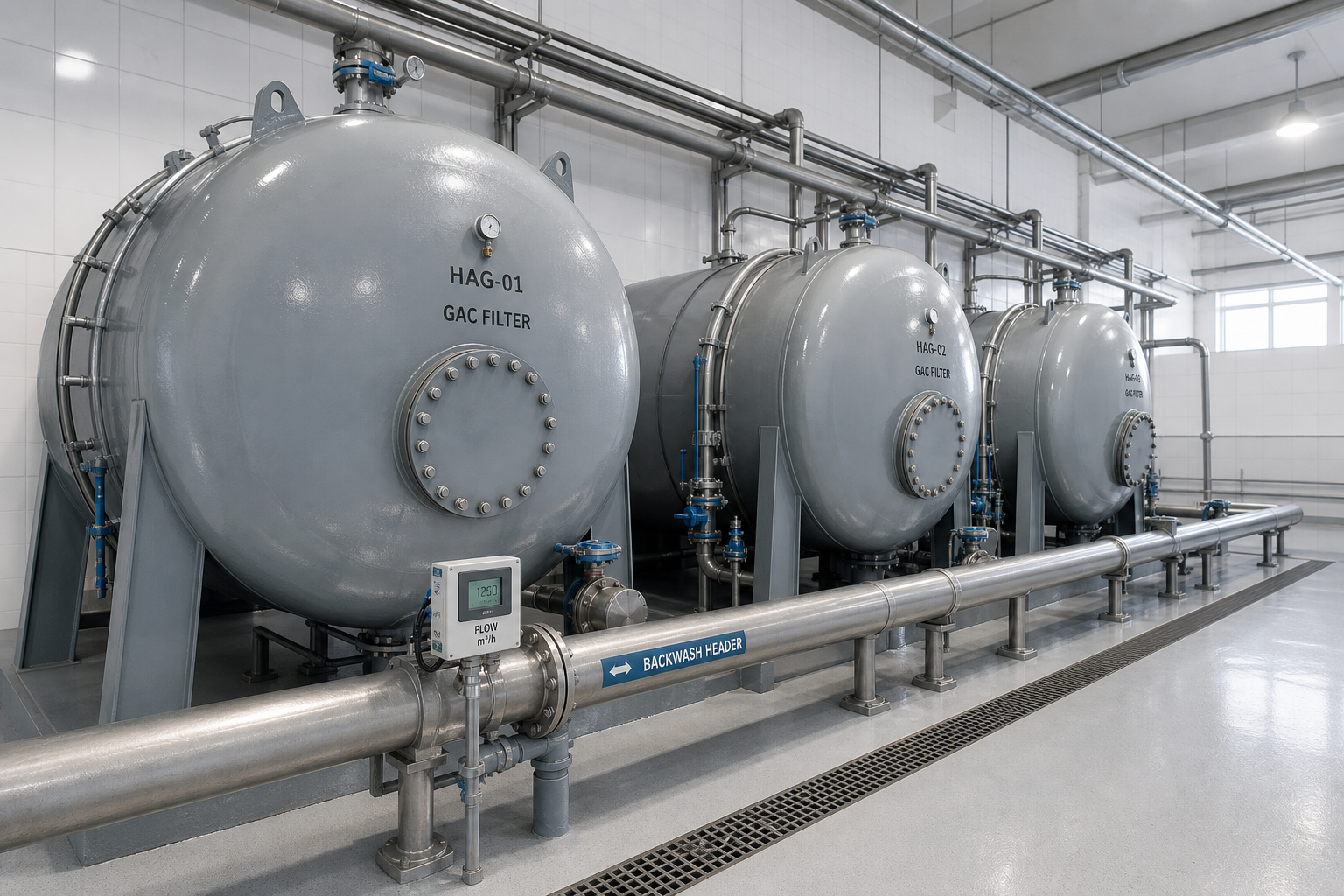
Physical condition matters as much as adsorption capacity. Repeated backwashing gradually fractionates the bed, and the fines migrate toward the top while the larger grains settle at the bottom. Over time this stratification raises pressure drop, shortens the useful mass transfer zone and can push carbon out through the underdrain. Correct backwashing — enough flow to achieve roughly 20 to 30 percent bed expansion, at a rate that does not wash whole grains over the trough, followed by a proper rinse — is the single most cost-effective way to protect bed life. Backwashing only when pressure drop becomes a problem is a false economy, because by then the fines have already redistributed the bed.
When the numbers confirm exhaustion, the choice between fresh carbon and thermal reactivation comes down to economics and duty. Reactivation is generally the lower-cost option for large charges used in taste, odour and general organics removal, but it comes with a modest loss of surface area and mechanical strength on each cycle, so a reactivated carbon should be assessed on its iodine value and abrasion number rather than accepted on price alone. For high-purity duties — drinking water with strict trace-organic limits, food and pharmaceutical applications, or any bed where catalytic or impregnated carbon is used — fresh carbon is normally the safer specification. Either way, monitor the same breakthrough parameter on the new charge from day one, and you will have a real service life figure for your own plant rather than an estimate borrowed from a supplier's datasheet.


 Get Free Sample
 WhatsApp