Powdered activated carbon is not a smaller version of granular carbon; it is a different way of running a plant. The powder is dosed as a slurry, travels with the water for a defined contact window, and is then captured in the clarifier or the filter and leaves with the sludge. It cannot be regenerated and is never recovered. That makes PAC a response tool rather than a permanent barrier: it is brought in for seasonal taste and odour episodes, algal blooms, pesticide peaks and contamination incidents, and withdrawn when the event passes. Because cost is charged per kilogram consumed, dose efficiency is the whole economics of the application.
Adsorption only happens while a particle is still in contact with the water, so contact time and dosing point decide the outcome. A working target is a contact window on the order of 15 to 30 minutes, and much of the practical design work is simply deciding where to inject the slurry. Common design guidance is to add PAC a few minutes upstream of the coagulant, so that adsorption begins before the floc forms and before carbon particles are enmeshed in it; reversing the order measurably reduces removal. Once PAC is trapped inside floc, it is effectively out of the process, which is why the useful contact time is always shorter than the theoretical basin residence time. Plants that monitor raw water quality upstream can begin dosing before the compound reaches the intake, which is often worth more than any change of grade.
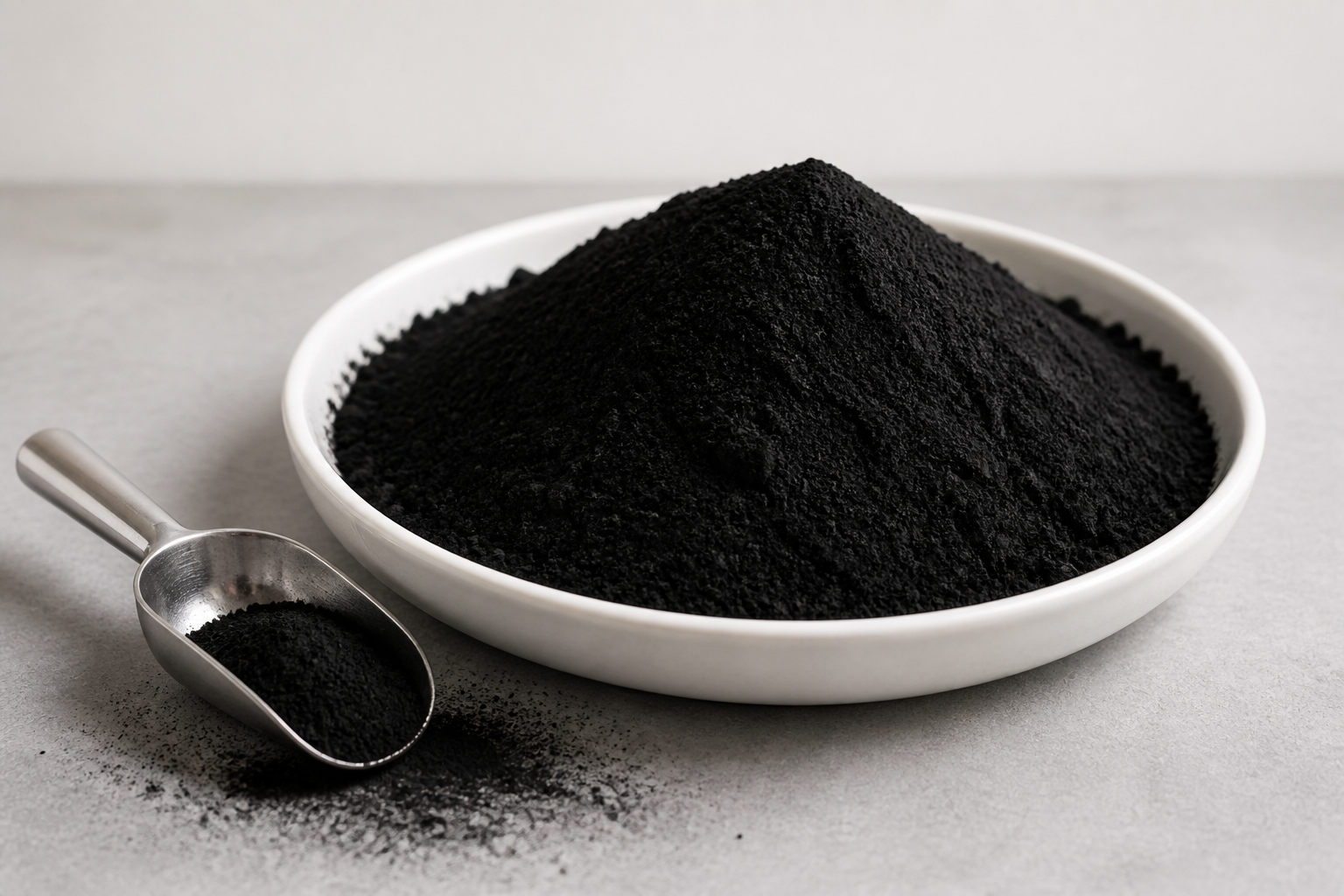
The dose itself is set by the target compound and by background organic matter, which competes for the same adsorption sites. In taste and odour trials on raw waters, a dose around 30 mg/L has delivered roughly 70% to 87% removal of geosmin, while doses of only 2 to 8 mg/L frequently fail to bring the compound below its odour threshold. Because natural organic matter occupies sites that the target molecule would otherwise use, the dose needed rises with dissolved organic carbon, and water that has changed after heavy rain may need a different dose from the same plant a month earlier. Grade selection follows the same logic. Iodine value is the primary indicator for small-molecule organics and should sit at 800 mg/g or above for liquid-phase duty; methylene blue value indicates capacity for medium molecular weight compounds and molasses number the mesopore-driven removal of colour and larger molecules. Fine grades, below 200 mesh, are preferred for potable water because adsorption rate rises as particle size falls.
Specification is therefore an exercise in measurement rather than assumption. Jar tests or rapid adsorption tests run on the actual raw water, at the intended dosing point, give a defensible dose; a grade that reaches the target at 20 mg/L is cheaper than a lower-cost grade that needs 35 mg/L, even at a higher price per tonne. Two operational points repay attention: the powder must be properly wetted and dispersed in the slurry tank, since dry powder that forms lumps never adsorbs at all, and supply must be able to follow an event, because demand can multiply within days of an algal bloom or a spill. Grades are supplied in the fineness ranges potable water plants use, with the iodine, methylene blue and ash data needed to compare them on a like-for-like basis.


 Get Free Sample
 WhatsApp